 Porto Wine Tours
Vintage Port: What Makes a Vintage, and How It Differs From LBV
Vintage port is the top rung of the Port ladder: one single year, declared by the house that made it, bottled after only two to three years in wood and then left to mature in bottle for decades. This page explains who declares a vintage, what the rules say, how late bottled vintage port differs, and where to taste vintage port wine and LBV in Porto and Vila Nova de Gaia. If you are comparing the fuller list of Port styles, start with port wine tours in Porto and the style guide, then come back here for the years that matter. Every figure below comes from the IVDP, the houses themselves or the tour listings.
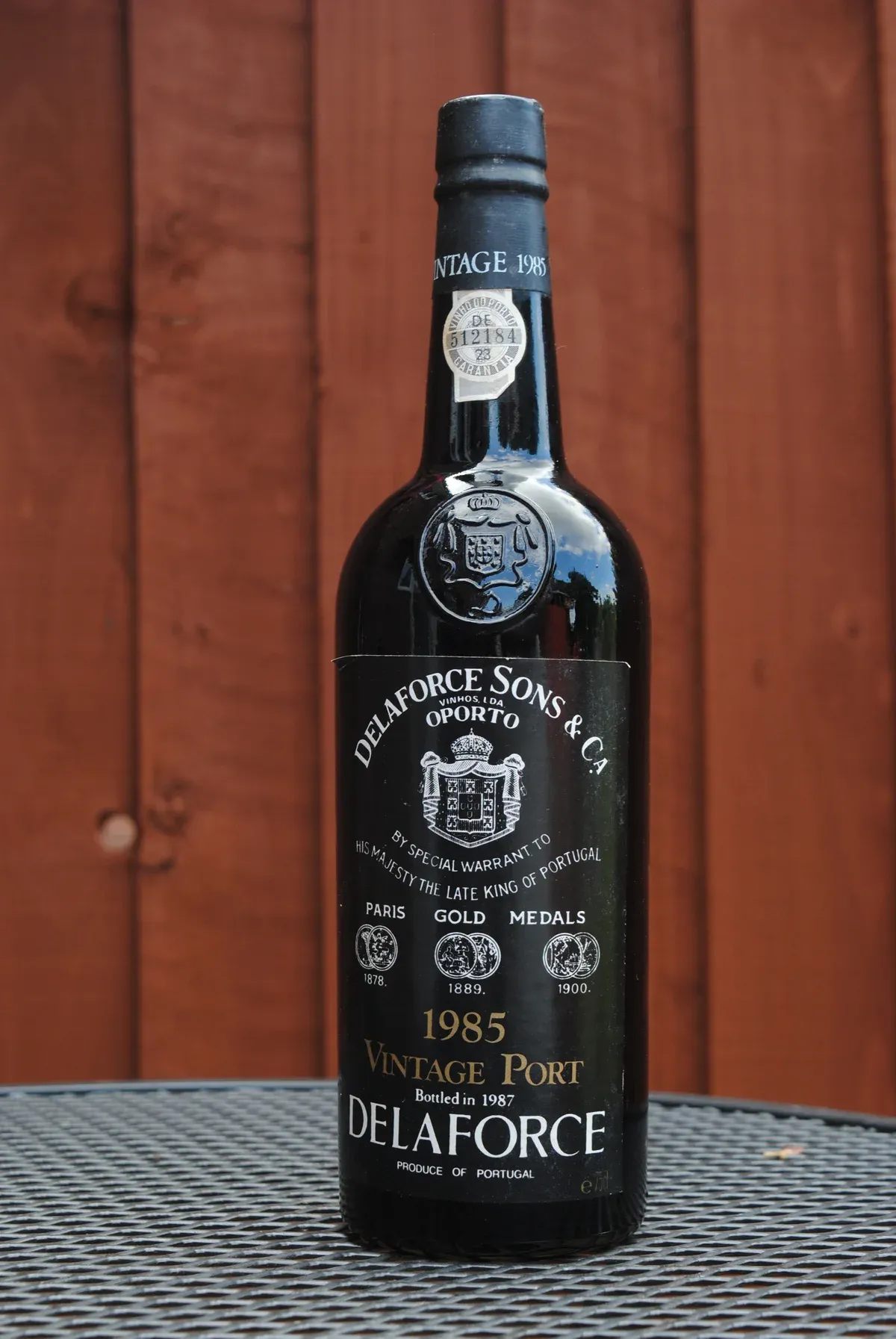
A bottle of Delaforce 1985 Vintage Port. Photo: Andy Mabbett, CC BY-SA 4.0, via Wikimedia Commons
Quick answer Vintage port in brief
Vintage port is a Port from a single year's harvest, bottled two to three years after the vintage, that then ages in bottle for 10 to 50 years according to the IVDP. Taylor's says historically only about three vintage years per decade are declared, and the decision belongs to each house.
Key takeaways
- A vintage is declared by the house in the spring of the second year after harvest. Taylor's historically declares about three years per decade, and lists its declared years on its own page.
- LBV is also a single-year Port, but it spends four to six years in wood and is ready to drink when bought. See the vintage vs LBV comparison.
- An opened bottle of Vintage Port keeps only 1-2 days per the IVDP, against 4-5 days for LBV. Decanting and serving details are in the serving section.
- To taste Port where it ages, book one of the Gaia lodge tours such as Graham's premium tasting from $45.
What Makes a Vintage Port
Three things separate a vintage from every other Ruby-style Port: a single harvest, a house decision, and a long life in bottle rather than in cask.
A Single Year, Bottled Young
The IVDP defines Vintage Port as a wine from a single year's harvest, bottled two to three years after the vintage. Wines of Portugal sharpens the window: bottling happens between 1 July of the second year and 31 December of the third year after the harvest, and the wine may be kept up to 40 years in the ageing cellars before release. Compare that with a tawny or a colheita, which spends most of its life in wood. Vintage Port ages in bottle. Young, the IVDP describes an intense ruby colour with red fruits and wild berries. Mature, the wine picks up garnet tones. Fortification stops fermentation with grape spirit at about one part spirit to four parts wine, which is why the finished wine sits at 19-22% vol and keeps residual sweetness.
Because the wine spends only about two years in vat before bottling, whatever it will become, it becomes in the bottle. That is why a vintage throws a deposit as it ages and needs decanting, and why a bottle from a great year can outlive the person who bought it.
The House Declares, Not the Regulator
Each house decides whether to declare. The decision is made in the spring of the second year after the harvest, after the wine has spent two winters in oak vats. Taylor's makes its announcement on Saint George's Day, 23 April. A declared blend must be of outstanding quality, austere in youth with great depth and structure. Taylor's says historically only about three Vintage years are declared per decade.
The declared years Taylor's lists on its Classic Vintage page are 2024, 2018, 2017, 2016, 2011, 2009, 2007, 2003, 2000, 1997, 1994, 1992, 1985, 1983, 1980, 1977, 1975, 1970, 1966 and 1963. Houses do not always declare together. Symington called 2017 a classic Vintage year, its first back-to-back general declaration since Andrew James Symington arrived in Porto in 1882 and the sixth declaration of the 21st century, covering Graham's, Dow's, Warre's and Cockburn's. Yields that year ran about 20% below the 10-year average and the harvest started in August, the earliest in the family's history. Sandeman names 2018 as one of its declared years. For the wider style list beyond the Ruby family, see what is port wine.
What Goes Into the Blend
A declared vintage is not one vineyard. Taylor's builds its Vintage blends from Quinta de Vargellas, which gives structure and elegance, and Quinta de Terra Feita and Quinta do Junco, which give body and fruit. A concrete recipe exists in the Ramos Pinto Vintage 2004 sheet: Touriga Nacional 60%, Touriga Francesa 30% and Tinta Roriz 10%, fermented 4-5 days in granite lagares, finished at 20% alcohol with 84.2 g/l of residual sugar.
There is also a single-estate version. The IVDP lists Single Quinta Vintage as a single harvest from a single quinta.
Vintage, LBV and Crusted
All three sit in the Ruby family. The differences are how long the wine stays in wood, whether it comes from one year, and if you must decant it.
The Three Bottles Side by Side
The table pulls the ageing rules from the IVDP special categories page, Wines of Portugal and the house sheets. Vintage spends the least time in wood and the most in bottle. LBV spends four to six years in wood and is usually ready on release.
Crusted is a blend rather than a single year, kept in bottle at least three years before sale, and it throws a deposit called the crust because it is not filtered.
| Style | Years | Ages in | Decant |
|---|---|---|---|
| Vintage | Single year, bottled 2-3 years after harvest | Bottle, 10-50 years | Yes, older vintages per IVDP |
| LBV | Single year, bottled after 4-6 years in wood | Wood, then bottle, most ready to drink | Usually no, unfiltered versions yes |
| Crusted | Blend of vintages, 3-4 years in wood | Bottle at least 3 years before sale | Yes, it forms a crust |
When LBV Is the Better Buy
Late bottled vintage port exists because someone spotted a gap. Taylor's launched the first LBV in 1970, the 1965 released by Alistair Robertson, as an affordable, ready-to-drink alternative to Vintage. The trade-off is the opposite of a vintage: LBV matures 4-6 years in wood against about two years for Vintage, so the wine is ready on bottling. Taylor's says it plainly: no decanting needed, and the bottle stands up by the glass for several weeks after opening.
The category is big. LBV is one in five Port purchases in the UK and over a quarter of the Port drunk in Canada, and Taylor's holds 34% of LBV sales by value. If you want the single-year character without the long wait or the decanter, LBV is the honest answer. One warning: since the IVDP banned the term vintage character in 2002, bottle-matured LBV must age at least three years in bottle before release, so check which version you are buying. Filtered LBV needs nothing. Unfiltered LBV, such as Fonseca's, benefits from decanting. For how the ruby and tawny families differ overall, see ruby vs tawny port.
Crusted, the Poor Relation Worth Knowing
Per the IVDP, Crusted Port is a blend of wines of intense colour and full body, kept in bottle at least three years before sale, and it throws a deposit called the crust. Taylor's adds that it is not from a single vintage and is not filtered before bottling. Wines of Portugal puts the wood time at 3-4 years before bottling.
Think of it as vintage-style bottle ageing without the declaration. You still decant it, you still get sediment. What it does not give you is the name of a year on the label in the vintage sense, because it is a blend. If your question is whether a bottle will improve for decades, vintage is the only one of the three with a 10-to-50-year bottle-ageing window in the IVDP definition.
Sources: IVDP, Taylor's LBV
Decanting Vintage Port
How a bottle of vintage port is opened and decanted off its sediment. Third-party video by Symington Family Estates. This site did not shoot it and has no relationship with the creator.
Decanting and Serving a Vintage
Vintage port is the style on this page that most needs a decanter, and the one that keeps the shortest time once open.
Decant Before You Pour
The IVDP recommends decanting older Vintage Port and serving it in large glasses. The reason is physical: the wine has spent decades in bottle, it has shed a crust of sediment, and the deposit is part of what bottle ageing gives you. Sandeman's advice for Vintage is to serve it at 16-18 C and decant, while the Ramos Pinto Vintage 2004 sheet says to open the bottle two hours before serving and decant. Unfiltered LBV is the one exception in the LBV row: Fonseca's unfiltered bottling is bottled without fining or filtration and benefits from decanting, while a standard filtered LBV, per Taylor's, needs no decanting at all.
Serve Ruby-style Port at 12-16 C per the IVDP, with the houses running slightly warmer: Sandeman suggests around 18 C for Vintage. Glassware matters too. Sandeman recommends glasses of at least 35 cl.
How Long It Keeps Once Open
Here vintage has the shortest life. The IVDP opened-bottle guide gives Vintage 1-2 days, LBV and Crusted 4-5 days, Ruby and Ruby Reserve 8-10 days, and age-indicated tawnies 1-4 months. Sandeman is a touch more generous on both ends: Vintage keeps 2-3 days after opening, Ruby is best within a month. Taylor's makes the practical point for LBV, that the bottle stands up by the glass for several weeks after opening, and Fonseca's unfiltered LBV sheet gives an optimum of two months.
The lesson for planning is simple. Open a vintage when you have a table of people to drink it with, finish it that evening or the next, and open an LBV when you want a bottle that lasts longer, though the sources disagree on how long. Storage before opening follows the same split: Sandeman says non-vintage bottles stand upright and Vintage lies down, in a cool dark place, so the cork stays moist. Ramos Pinto gives 17-18 C for storing its Vintage on its side.
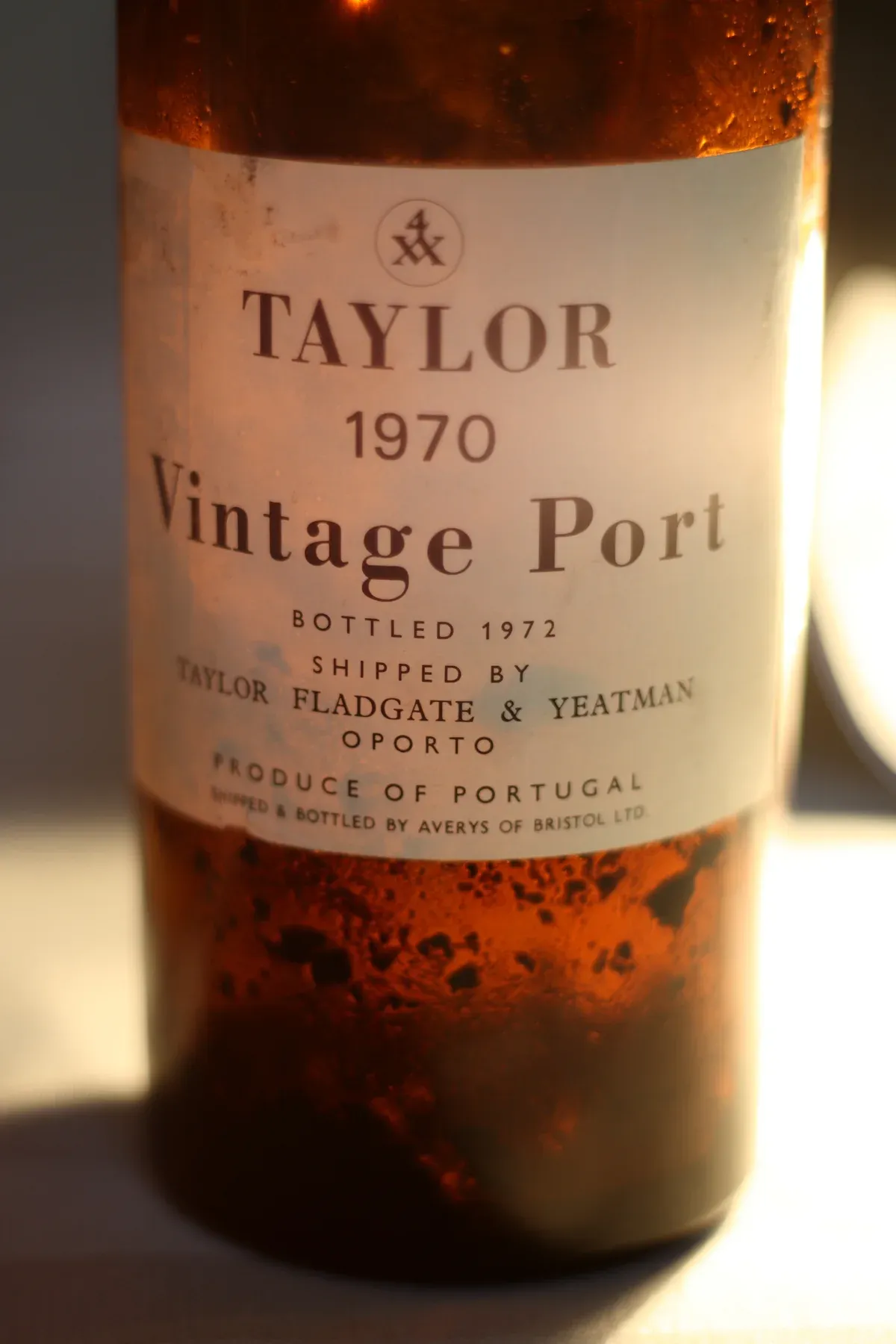
A bottle of 1970 Taylor vintage port with its sediment visible. Photo: Ed Brambley, CC BY-SA 2.0, via Wikimedia Commons
Where to Taste Vintage Port in Porto
Vintage is the expensive end of any tasting list, so most bookable tours pour Ruby, LBV, Reserve and Tawny, and only a couple of options name a Vintage among the pours. Here is what the listings actually include.
Tours That Pour LBV and the Better Ports
The clearest LBV pour on the bookable list is at Poças. The Poças Port Cellar Tour costs $26 for a 1.5-hour guided visit to a century-old aging cellar, with a tasting of 3 Port wines in the tasting room, and the listing names white, LBV and Reserve Tawny as the pours. LBV also appears in the listed pours of the Taylor's, Graham's, CD Porto and Cálem tickets. At the top end, the Graham's Port Lodge Tour costs $45 for 2 hours at the working 1890 Graham's lodge, with a paired Port tasting in the main tasting room looking at the Dom Luís bridge. You choose Premium with pairings or Port Essentials, and Graham's is one of the houses Symington declared in 2016 and 2017, so vintage is the house's business, and the Port Essentials option lists a Quinta dos Malvedos Vintage among its pours.
Two wider tours pour more glasses, and the pours are of Port generally rather than vintage specifically. The Port Wine Lodges Walking Tour from Porto Walkers costs $64.14 for 3.5-4 hours, three port houses and 7 tastings with entry tickets included. The Port and Douro Wine Tasting Tour costs $56.12 for 3 hours, three Gaia lodges and 9 tastings of Port and DOC Douro wines, the most pours in this comparison. The Porto Walkers listing names lunch and hotel pickup as not included.
Single-Lodge Tickets Worth Adding
The cheapest entry point is Real Companhia Velha at $22 for a 1-2 hour guided tour of the two-hundred-year-old cellars, access to the private Silva Reis family cellar with its 16,000 bottles, and a tasting of selected Ports. Sandeman costs $26 for a 50-minute guided visit to cellars where Port has aged since 1811, with White, Ruby and Tawny pours, and Sandeman names 2018 as a declared year. Taylor's costs $28 for a self-guided cellar tour with an audio guide in 13 languages and 3 ports in the garden. Fonseca pairs its $28 cellar tour with a live Fado show and 2 ports.
If you would rather go straight to a house, Ferreira sells its Dona Antónia Visit on its own site, with 5 Port wines over 1h30. Check the current price there, as Ferreira's own pages did not agree on it.
Prices from the tour listings
Vintage Port Questions
What is considered vintage Port?
A Port from a single year's harvest, bottled two to three years after the vintage, that then ages in bottle. Wines of Portugal sets the bottling window between 1 July of year two and 31 December of year three after the harvest, and the IVDP gives the wine a 10-to-50-year bottle life. The full definition is in the what makes a vintage section.
What is a good vintage Port?
A declared year from a house with a track record. Taylor's lists 2024, 2018, 2017, 2016, 2011, 2009, 2007, 2003, 2000, 1997, 1994, 1992, 1985, 1983, 1980, 1977, 1975, 1970, 1966 and 1963 among its declared years, and Symington declared 2016 and 2017 for Graham's, Dow's, Warre's and Cockburn's. See the declared years list.
What's the difference between vintage Port and tawny Port?
Vintage ages in bottle after two to three years in wood, while tawny ages in cask for years or decades, which is why the IVDP says an opened tawny keeps 1-4 months against 1-2 days for a vintage. The full wood-versus-bottle split is in the serving section, and the style-by-style comparison lives on the ruby vs tawny page.
Is LBV port the same as vintage port?
No. LBV is also a single-year Port, but it spends four to six years in wood before bottling instead of two to three, so it is ready to drink on purchase and usually needs no decanting. Taylor's launched it in 1970 as exactly that alternative. The comparison table is in the vintage vs LBV section.
How long does vintage port last after opening?
Not long. The IVDP gives an opened Vintage 1-2 days, LBV and Crusted 4-5 days, and Ruby 8-10 days. Sandeman is slightly more generous, giving Vintage 2-3 days. The numbers sit in the keeping and storage block.
Do you have to decant vintage port?
Yes for older bottles. The IVDP recommends decanting older Vintage Port and serving it in large glasses, Sandeman says to decant and serve at 16-18 C, and Ramos Pinto says to open two hours before serving. Filtered LBV is the exception and needs no decanter. Details are in the decanting block.
Can I taste vintage Port on a tour in Vila Nova de Gaia?
Most bookable tours pour Ruby, Tawny and LBV. The Graham's Port Essentials option lists a Quinta dos Malvedos Vintage and one Cálem option lists a Vintage, and the clearest named LBV pour is the Poças Port Cellar Tour at $26. For a house that declared 2016 and 2017, the Graham's Port Lodge Tour costs $45 with a paired tasting. Options are listed in the tasting section.