 Porto Wine Tours
What Is Port Wine?
What is port wine? It is a fortified wine from the Douro Valley in northern Portugal, usually 19-22% alcohol, sweet, and aged in the lodges of Vila Nova de Gaia across the river from Porto. This guide explains what makes port port, how it is made from grape to bottle, and the full range of types of port wine, from Ruby to 40 Year Old Tawny. It is written for travelers who will taste port in Porto and want to know what is in the glass before they get there. When you are ready to taste, the Porto wine tours compare the cellar visits and guided lodge walks on both riverbanks.
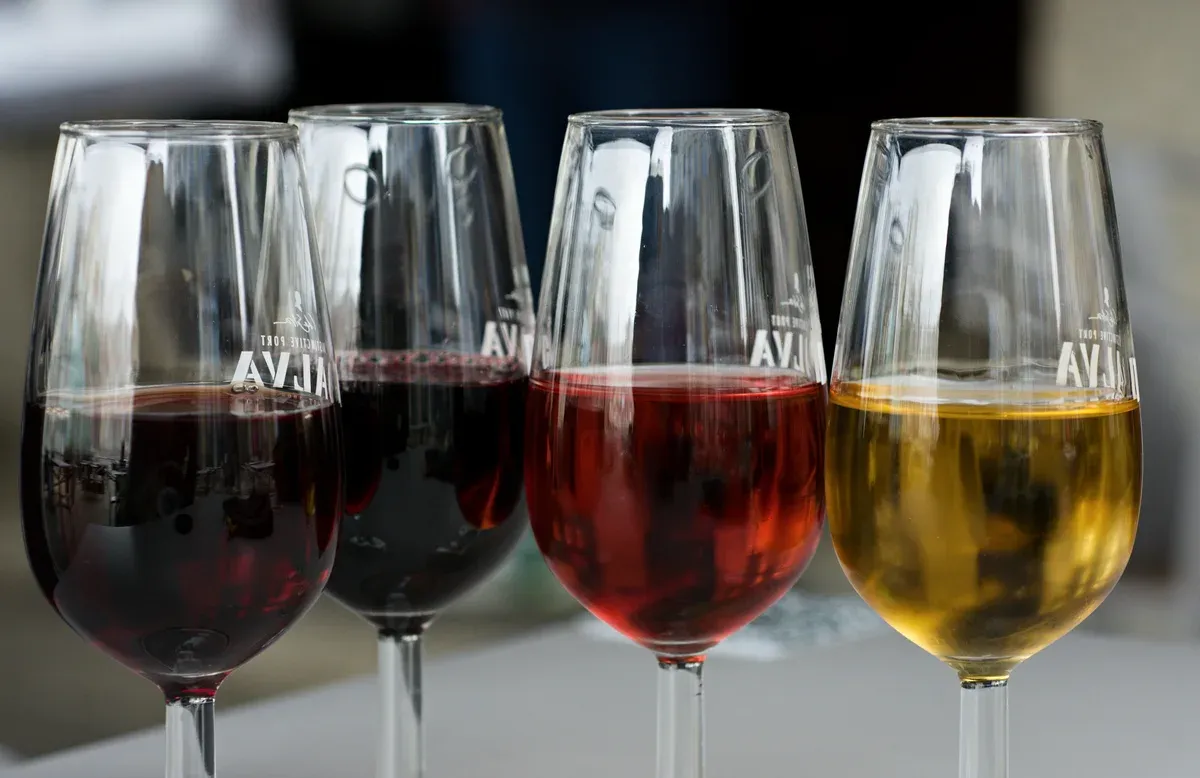
Four glasses of port from white to deep ruby poured side by side. Photo: Topi Pigula, CC BY-SA 4.0, via Wikimedia Commons
Quick answer Port in one answer
Port wine is a fortified wine produced in the Demarcated Region of the Douro in Portugal, usually with an alcoholic strength between 19 and 22% vol. Fermentation is stopped early by adding grape spirit, which leaves natural grape sugar in the finished wine, so port tastes sweet. The regulator is the IVDP, the Instituto dos Vinhos do Douro e do Porto. Port ages either in the Douro or in the Vila Nova de Gaia lodges, and Gaia is where you taste it.
Key takeaways
- Port is sweet because grape spirit at 77% alcohol stops fermentation while roughly half the grape sugar remains, a method still used today.
- The IVDP groups port into Ruby (Ruby, Reserve, LBV, Vintage), Tawny (Tawny, Reserve, 10/20/30/40 years, Colheita), White and Rosé. See the full table of types of port wine below.
- The vineyards were demarcated on 10 September 1756, and the flat-bottomed rabelo boats once carried the barrels down the Douro to Gaia.
- The easiest way to connect styles to real glasses is the Port Wine Lodges Tour with 7 tastings, which covers three port houses in about 4 hours.
Port Wine in One Paragraph
One paragraph of definition, and why the answer to what is a port wine always ends in Vila Nova de Gaia.
The Four Things That Make It Port
The IVDP, the official Portuguese wine institute, defines Port as a fortified wine, as defined in EU legislation, produced in the Demarcated Region of the Douro. Four things separate it from ordinary table wine. First, the grapes must come from the Douro Demarcated Region, a territory of about 250,000 hectares in northern Portugal where vines cover roughly 18% of the land. Second, fermentation is interrupted with grape spirit, which fixes the sweetness. Third, the finished wine is strong: port usually sits between 19 and 22% vol, and the dry white style known as Light Dry White Port must still reach at least 16.5%. Fourth, everything is classified by the IVDP, which also approves every drop of grape spirit used before it can touch the wine.
The result is a sweet wine. The IVDP sweetness scale runs from extra dry, under 40 g/l of sugar, up to very sweet, over 130 g/l. Colour runs from deep red to light gold, and aged white ports can pick up golden tones close to an old tawny. The winemaker, not the grape alone, decides where on that scale a wine lands, because the sweetness is set at the moment fermentation is stopped.
Where Port Ages, and Why Gaia Matters
Grapes are grown and wine is made in the Douro, but for most of its history the wine came downriver to age. The IVDP states that port wines age either in the Douro or downriver in the Vila Nova de Gaia bonded lodges, the row of cellars facing Porto across the Douro. Until 1986, port for export had to be shipped from the Gaia entrepôt. The flat-bottomed rabelo boats carried the barrels down the river. Those boats still exist as working symbols, and port companies still keep rabelos on the river, with a race held on 24 June for the São João festival.
That history is exactly what you walk through today. The lodges sit a short walk from the Ponte Luís I, and you can visit them on your own or on a guided walk such as the Port Wine Lodges Tour Including 7 Port Wine Tastings, which takes in three port houses. For the riverside setting and how to get across the bridge, see the page on Vila Nova de Gaia.
How Port Is Made
From Douro vineyard to Gaia lodge, port takes a fixed path: pick ripe, ferment briefly, fortify, then age long. Here is the sequence, with the figures.
The Grapes
About 30 grape varieties can go into port, though most modern vineyards plant five or six top reds. The main red varieties listed by Taylor's are Touriga Franca, Touriga Nacional, Tinta Roriz, Tinta Barroca, Tinta Amarela and Tinto Cão. Touriga Francesa is the most widely planted in the Douro Valley.
Touriga Nacional has small thick-skinned berries and low yields and gives dark, concentrated, tannic wines. Tinta Barroca gives soft, round, fragrant wines with more colour than structure, and Tinto Cão is one of the oldest Douro varieties and the least planted because of very low yields. Red ports are made from riper grapes with high sugar, tannin and colour.
White grapes are picked earlier to keep aroma and acidity. The harvest window itself is wide: the IVDP says it begins each year between the end of August and mid-October.
Fortification With Grape Spirit
This is the step that answers how port wine is made sweet. Fermentation turns grape sugar into alcohol. While it runs, roughly half the natural grape sugar has become alcohol, the winemaker adds neutral grape spirit, which Taylor's gives as brandy at 77% alcohol. The spirit kills the yeast, fermentation stops, and the sugar left behind stays in the wine. The most frequently used proportion, per the IVDP, is one part spirit to four parts of must-wine, which Taylor's expresses as about 115 litres of brandy to 435 litres of fermenting wine. After fortification the wine keeps its residual sweetness and reaches 19-22% alcohol. The IVDP requires that all grape spirit used for port be approved by the institute before use.
Traditionally the grapes were trodden by foot in stone lagares, and that continues. Taylor's describes two treading stages: the corte, where workers advance shoulder to shoulder, and the liberdade, individual treading that keeps the skins under the surface. White ports work differently. The extra dry, dry and semi-sweet whites are fermented longer to reduce residual sugar, which is how a port ends up dry at all.
The Steps, in Order
Every port, from a basic Ruby to a 40 Year Old Tawny, follows the same opening sequence. What changes is the ageing decision made afterwards.
- Harvest in the Douro, starting between the end of August and mid-October.
- Crush and tread the grapes, traditionally by foot in granite lagares.
- Ferment until about half the natural grape sugar has turned to alcohol.
- Add IVDP-approved grape spirit at 77% alcohol, about one part spirit to four parts wine, stopping fermentation at 19-22% vol with sweetness intact.
- In the spring after the harvest, make a first selection and blending and classify each wine by its potential.
- Age in wood or bottle, in the Douro or in the Vila Nova de Gaia lodges, for a period set by the style.
- Blend, filter where the style requires, bottle, and have the IVDP certify the finished port.
Ageing in Wood or Bottle
After harvest the wine stays at the Douro winery until spring, then moves to the Vila Nova de Gaia lodges. From there the fork in the road appears. Ruby styles age in large vats or bottles to keep their fruit and deep colour.
Tawny styles age in oak casks, where slow oxidation turns the wine gold-brown and nutty. Even in cask the wine keeps changing: Taylor's notes that in the first years of cask ageing, evaporation, the angel's share, can reach 2% a year, which concentrates sugars, acids and aromas. Bottle-aged styles, led by Vintage, do the opposite, developing in a sealed bottle over decades.
That single decision, wood or bottle, is what produces the two great families of port described further down this page.
Port 101: The Basics of Port Wine
A short lesson on how port is made and the main styles you meet in a tasting. Third-party video by V is for Vino Wine Show. This site did not shoot it and has no relationship with the creator.
The Types of Port Wine
The IVDP sorts every port into families, and each family answers a different question about ageing.
Every Style at a Glance
The table below lists the port wine types the IVDP recognises, grouped into the Ruby and Tawny families plus White and Rosé. Ageing figures and taste notes come from the IVDP, Wines of Portugal and the port houses themselves. Where a source gives no taste description, the cell says not stated.
| Style | Family | Ageing | Taste |
|---|---|---|---|
| Ruby | Ruby | About 2-3 years in vat or wood | Cherry, blackberry and blackcurrant fruit |
| Ruby Reserve | Ruby | Slightly longer than Ruby | Full-bodied, rich and deep ruby |
| Crusted | Ruby | 3-4 years in wood, then at least 3 years in bottle | Intense colour and full body, throws a deposit called the crust |
| LBV | Ruby | 4-6 years in wood, single year | Not stated |
| Vintage | Ruby | About 2 years in vat, then bottled, ages 10-50 years in bottle | Young: intense ruby with red fruits and wild berries. Mature: garnet tones |
| Single Quinta Vintage | Ruby | Single harvest from a single quinta | Not stated |
| Tawny | Tawny | Aged in oak | Not stated |
| Tawny Reserve | Tawny | Aged in oak, average about 5-7 years | Not stated |
| Tawny 10/20/30/40 years | Tawny | Blend aged an average of the stated years in oak casks | Not stated |
| Colheita | Tawny | Single-year tawny, at least 7 years in cask | Not stated |
| White (six styles, extra dry to Lágrima) | White | Usually 2-3 years in large vats, Reserve about 7 years in wood | Not stated |
| Rosé | Ruby family | Lightly macerated red grapes, drunk young | Light, fresh and fruity |
The Ruby Family
Ruby ports are the fruit-driven family. Basic Ruby ages about two or three years in vat or wood and shows cherry, blackberry and blackcurrant fruit. Ruby Reserve is a step up: the IVDP describes it as full-bodied, rich and deep ruby, frequently a selection of the best port made each year.
Crusted Port is a blend of intense colour and full body, kept in bottle at least three years before sale, unfiltered, so it forms the crust that names it. LBV is a single-year Ruby aged four to six years in wood, and most bottles are ready to drink on purchase. Vintage is the peak: a single declared year, bottled two to three years after harvest, that develops in bottle for 10 to 50 years.
The IVDP grades Vintage 9, exceptional, and LBV, Crusted and Colheita 8, high, on its sensory scale. For the full story of the top styles, see the guide to vintage port.
The Tawny Family
Tawny ports are the wood-aged family, and this is what tawny port means: port aged in oak casks long enough to lose its deep red colour and gain amber-brown tones from slow oxidation. Basic Tawny and Tawny Reserve, which has an average age of about five to seven years, are the entry point. Above them come the age-indicated tawnies, blended to an average of 10, 20, 30 or 40 years.
The stated age is the approximate average age of the wines in the blend, not the youngest wine in it. A Sandeman 30 Year Old, for example, is a selection of wines between 25 and 40 years of age. Colheita is the single-year version: a tawny from one harvest aged a minimum of seven years in cask.
Houses go further, with Graham's and Quinta do Noval both listing 40 Year Old tawnies and Sandeman listing categories up to 50 years. Ruby against tawny in depth, with food pairings, sits on the ruby vs tawny port page.
White and Rosé
White Port is made from white grapes and comes in six IVDP styles: extra dry, dry, semi-sweet, sweet, very sweet and Lágrima, with the Light Dry style at a minimum of 16.5% alcohol. Most white port ages two or three years in large vats. White Reserve is aged in wood for about seven years, and white port also has age-indicated and Colheita categories, so an aged white can develop golden tones like an old tawny. Younger whites are aperitif wines, longer-aged ones come after meals. Taylor's launched Chip Dry, the first dry white port, in 1934.
Rosé Port is a Ruby-style category made from lightly macerated red grapes, drunk young and chilled, with an IVDP serving temperature of 4 C. The first rosé port, Croft Pink, is described by the house as a light, fresh fruity style served very chilled or in cocktails. Both styles are the freshest, coldest glasses of port you will be poured in Gaia.
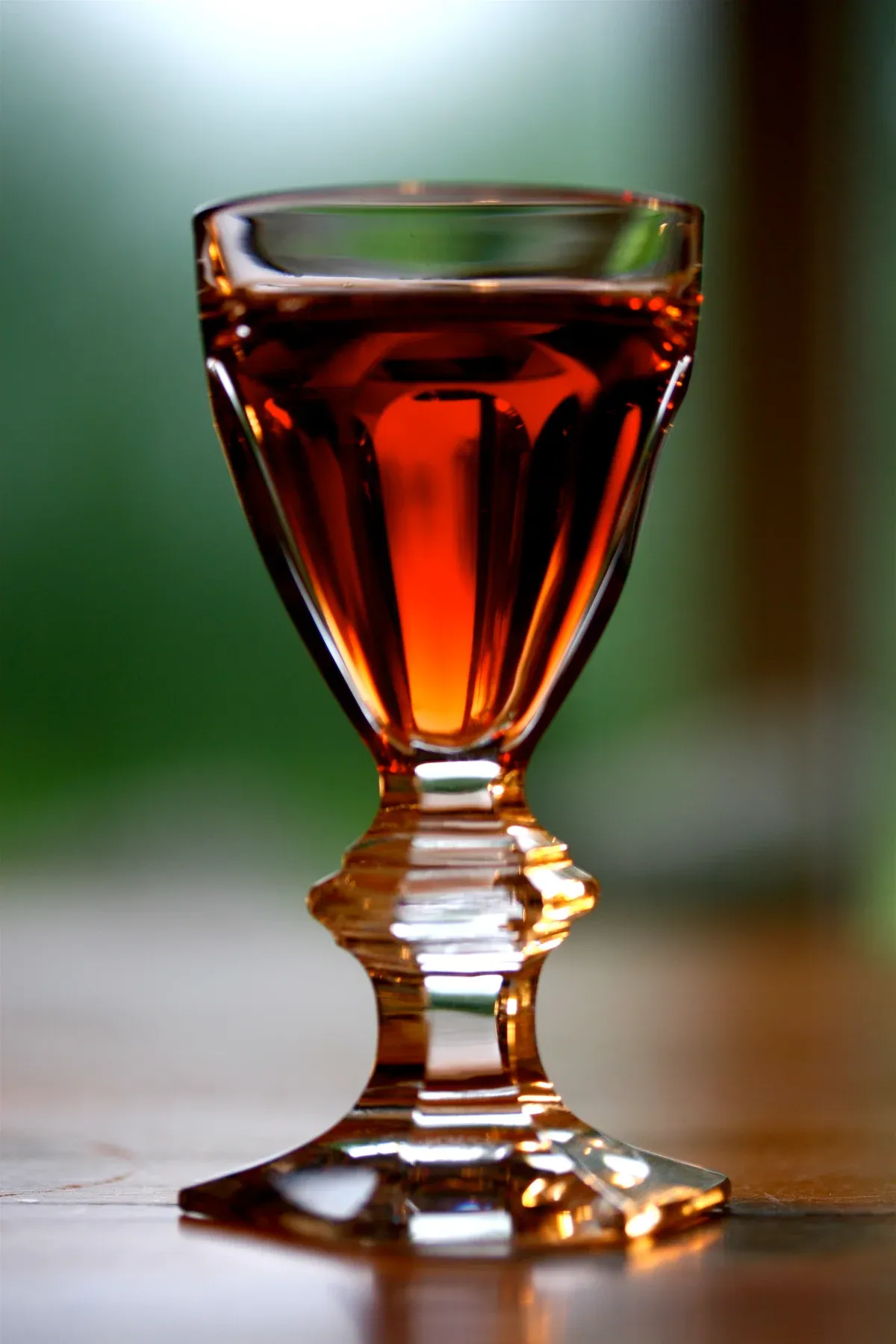
A single stemmed glass of tawny-coloured port on a wooden table. Photo: liz west from Boxborough, MA, CC BY 2.0, via Wikimedia Commons
How to Serve Port and How Long It Keeps
Port is stronger than table wine at 19-22% vol, so small pours go a long way. The IVDP publishes serving temperatures and opened-bottle life for each style, and this section gathers them in one place.
Serving Temperatures by Style
The IVDP gives one temperature band per style family. Rosé Port is the coldest at 4 C, white Port sits at 6-10 C, tawny style at 10-14 C and ruby style at 12-16 C. Individual houses sometimes widen those bands. Sandeman suggests ruby at 16-18 C and vintage around 18 C, while Taylor's suggests its 40 Year Old Tawny slightly chilled at 12-16 C and Quinta do Noval gives 10-14 C for the same style. A bottle chilled a little below room temperature is never wrong for a ruby.
Glassware matters too. Sandeman recommends glasses of at least 35 cl so the aromas have room, and the IVDP advises large glasses for older vintage port. Port is stronger than table wine, so a small pour goes a long way. You can absolutely drink port by itself, after a meal or with a small plate of cheese or nuts.
The table below uses the IVDP serving guide as the base figure for every style.
| Style | Serve at | Once open |
|---|---|---|
| Rosé Port | 4 C | not stated by the IVDP |
| White Port | 6-10 C | modern style 8-10 days, traditional white 15-20 days, aged white 1-4 months |
| Tawny and Tawny Reserve | 10-14 C | 3-4 weeks |
| Age-indicated tawny, Colheita | 10-14 C | 1-4 months |
| Ruby and Ruby Reserve | 12-16 C | 8-10 days |
| LBV and Crusted | 12-16 C (ruby family) | 4-5 days |
| Vintage | 16-18 C per Sandeman | 1-2 days |
Decanting: Which Bottles Need It
Only a few styles need a decanter. The IVDP recommends decanting older Vintage Port, which throws a heavy deposit after years in bottle. Sandeman repeats the advice and adds that a vintage should be opened and decanted ahead of drinking. Ramos Pinto's technical sheet for its 2004 Vintage asks for the bottle open two hours before serving, stored on its side at 17-18 C.
Most other ports are filtered and go straight to the glass. Taylor's states that its LBV needs no decanting and is ready to drink on purchase, and both Taylor's and Quinta do Noval say their aged tawnies need no decanting either, because the wine is filtered before bottling. Crusted port is the one exception in the ruby family. It is bottled without filtration and forms a deposit called the crust, so pour it carefully or decant it.
Storage is simple. Non-vintage bottles stand upright in a cool, dark place, per Sandeman. Vintage lies on its side so the cork stays moist.
- Decant: older Vintage Port, and any bottle with a visible deposit
- No decanting: filtered LBV and aged tawny, per the houses
- Store upright: everything except Vintage
- Store lying down: Vintage, so the cork stays moist
What Happens After You Open a Bottle
Port keeps better than table wine because of its 19-22% alcohol, but the clock runs at very different speeds by style. The IVDP guide gives Vintage the shortest life, 1-2 days once open, and Sandeman is only slightly more generous at 2-3 days. LBV and Crusted last 4-5 days on the IVDP table. Ruby and Ruby Reserve stretch to 8-10 days, and Sandeman says ruby is best within a month.
Wood-aged styles keep longest because long cask ageing already exposed them to oxygen. Tawny and Tawny Reserve keep 3-4 weeks per the IVDP, and age-indicated tawny, Colheita and aged white keep 1-4 months. The houses sit in the same range: Graham's asks for its 40 Year Old to be finished within 8 weeks, Sandeman gives its 30 Year Old 2-3 months, Quinta do Noval 3 months for its 40 Year Old and Burmester 2-4 months for a Colheita. Fonseca gives its unfiltered LBV an optimum of two months after opening, which is longer than the IVDP's 4-5 days for LBV generally, so check the back label of your own bottle.
Keep an open bottle upright, closed with its stopper, in a cool spot away from light.
Sources: IVDP choose and enjoy, Sandeman serving guide
Port's History in Short
Four dates explain most of what you see on the Gaia riverfront: 1756, the rabelo era, 1986 and 2001.
1756: The Demarcation
On 10 September 1756 the Marquis of Pombal founded the Companhia Geral da Agricultura das Vinhas do Alto Douro and demarcated the Douro vineyards, marking the boundary with 335 stone pillars called marcos pombalinos. Taylor's calls this the first vineyard demarcation in the world. Wikipedia ranks the Douro third among protected wine regions, after Chianti in 1716 and Tokaj in 1730, so the fair summary is that it is one of the earliest anywhere.
The classification work followed fast. In 1757 the first comprehensive ranking of Port vineyards was carried out, almost a century before Bordeaux attempted anything similar. English merchants had been shipping Port since long before that. Taylor's records the first shipment under the Port name in 1678, helped along by the 1654 commercial treaty and, earlier still, by the Anglo-Portuguese alliance set in the Treaty of Windsor of 1386. The 1703 Methuen Treaty cut duty on Portuguese wine entering England by a third compared with French wine, and shipments grew quickly over the next three decades.
The Rabelo Boats
Port is produced inland, but for centuries it could only be shipped through Porto. Flat-bottomed wooden cargo boats called barcos rabelos carried the barrels down the Douro to the Vila Nova de Gaia lodges.
The rabelo era as commercial transport is long over, but the boats never left. Port companies still keep rabelos moored on the river in front of the Gaia lodges, and a rabelo race is held every 24 June for the São João festivities. You can also sail the lower river on a cruise rather than in a cargo boat. The Port Wine River Cruise pours 4 port wines on a 2-hour boat tour along Porto and Gaia for $62.
1986: The End of the Gaia Export Monopoly
Until 1986, every bottle of Port destined for export had to be shipped from the Vila Nova de Gaia entrepôt. Portugal joining the EEC that year ended the monopoly. After the change, Port may ship from anywhere in the demarcated Douro region, and some producers now age and ship from the valley itself.
Taylor's describes the pattern: the wine stays at the Douro winery until spring after the harvest, then moves down to the Gaia lodges, where ruby and tawny styles mature in wood.
2001: UNESCO Recognition
The Alto Douro Wine Region was inscribed on the UNESCO World Heritage List in 2001 under cultural criteria (iii), (iv) and (v), with a listed area of 24,600 ha and a buffer zone of 225,400 ha. The vineyard landscape behind the wine had formal recognition at last.
The region itself is big. The IVDP puts the Douro Demarcated Region at about 250,000 hectares, of which vines cover about 18%, worked by roughly 20,000 farmers with an average holding of 2 hectares. Soils are mainly schist, with granite at the edges. If you want to see it rather than read about it, the Complete Douro Valley Wine Tour runs 10 hours from Porto with 6 tastings, lunch and a 50-minute rabelo cruise from Pinhão for $113.38, or browse the other Porto wine tours before deciding.
Sources: Taylor's history of Port, Wikipedia: Port wine, IVDP region facts
Where to Taste the Styles in Porto
Reading about port styles is one thing. Tasting a ruby beside a tawny in a Gaia cellar is how the difference sticks. Here is which bookable tour pours which styles, with the prices as listed on each platform.
Multi-Lodge Walks: The Widest Range in One Afternoon
If you want to understand the style families in a single booking, the multi-lodge walks do it best because each house pours a different selection. The Port Wine Lodges Tour Including 7 Port Wine Tastings by Porto Walkers runs 3.5-4 hours through 3 port houses, a traditional cellar, a small producer tasting room and a modern interactive museum, for $64.14 with lodge entry tickets included. Note what it leaves out: lunch, food, snacks and hotel pickup are not included, so eat first.
The CD Porto Tours option, the Port Wine Tour, 3 Cellars, 7 Tastings, 12 Participants Maximum, packs 3 producers within 400 m of each other into 2.5 hours for $61.84, capped at 12 people. It starts on the dot and latecomers cannot join.
For sheer variety of pours, the Port and Douro Wine Tasting Tour is the leader: 3 Gaia lodges, 9 tastings of Port and DOC Douro wines in 3 hours, up to 20 people, for $56.12. It meets at 14:30 at the Gaia tourism office on Avenida Diogo Leite 135. Gratuity and drinks outside the listed tastings are not included. For a deeper read on where each lodge sits, see the full guide to port wine cellars in Porto.
Single Lodge Visits: One House, Its Own Style Range
A single cellar visit goes deeper into one house and its house specialties. Taylor's offers a self-guided cellar tour with a 13-language audio guide and 3 tastings over 2-3 hours for $28 in the Taylor's Port Cellars and Tasting ticket. Bring headphones, because the audio guide plays on your phone.
Graham's, part of the Symington family stable, opens its 1890 lodge on a guided visit with a paired tasting in the main room for $45 over 2 hours in the Graham's Port Lodge Tour and Premium Wine Tasting. Transportation is not included and snacks cost extra on site.
Poças pours white, LBV and Reserve Tawny on its 1.5-hour guided visit for $26 in the Poças Guided Tour and Tasting of 3 Port Wines, a tidy way to compare three styles side by side. Sandeman's 50-minute tour, the Sandeman Cellar Tour with Port Wine Tasting, pours White, Ruby and Tawny for $26, the same three-way comparison in half the time. At Cálem, the Cálem Cellar Tour, Interactive Museum and Wine Tasting combines a 15-minute museum, a 30-minute cellar visit and 2 or 3 ports depending on the option, from $25. The cheapest entry is Real Companhia Velha: the Royal Oporto Tour visits its cellars and the Silva Reis private collection of 16,000 bottles with a tasting, from $22. Fonseca pairs its cellars with live fado on the Fonseca Cellar Tour and Fado Show, 2 ports for $28.
The table pulls all of these tickets together so you can match price to pouring.
| Ticket | Duration | Tastings | Price |
|---|---|---|---|
| Port Wine Lodges Tour (3 lodges) | 3.5-4 hours | 7 | $64.14 |
| Port Wine Tour, 3 Cellars | 2.5 hours | 7 | $61.84 |
| Port and Douro Wine Tasting Tour | 3 hours | 9 | $56.12 |
| Graham's Lodge Premium Tasting | 2 hours | paired tasting | $45 |
| Taylor's Cellars and Tasting | 2-3 hours | 3 | $28 |
| Poças Tour and Tasting | 1.5 hours | 3 | $26 |
| Sandeman Cellar Tour | 50 minutes | 3 | $26 |
| Cálem Cellar Tour | 1 hour | 2-3 | $25 |
| Real Companhia Velha Royal Oporto | 1-2 hours | selected Ports | $22 |
| Fonseca Cellar Tour and Fado | 1.5-4 hours | 2 | $28 |
Two Alternatives: On the River, or With Food
Two bookable options include port without a cellar visit. The 7 Bridges Port Wine River Cruise with 4 Tastings sails 2 hours along Porto and Gaia with 4 port wines and a certified crew for $62, boarding at R. da Praia 430 in Vila Nova de Gaia. There are no cellar visits on board. The nearby Luxury Yacht Cruise also sails 2 hours for $62.99 but pours Vinho Verde, not Port, so skip it if port styles are the goal.
If you would rather meet port at the table, the Delicious Food and Wine Walking Tour adds port with chocolate and a ginja tasting to a 3-hour walk with 10 food tastings for $83, up to 10 people. The Food Lover Tour serves 10-12 petiscos with a glass of Vinho Verde, a glass of Port and a beer for $79.02, but it is not suited to vegetarian, vegan or gluten-free diets. Whichever ticket you pick, every option above offers free cancellation 24h, and the full comparison of Porto wine tours sits on the homepage.
Prices in this section come from the tour listings on the booking platforms.
FAQ
How is Port wine different from regular wine?
Regular wine ferments until the yeast has eaten all the grape sugar. Port fortification adds grape spirit at 77% alcohol during fermentation, which kills the yeast and leaves natural sweetness in the finished wine at 19-22% vol, per the IVDP. See how port is made for the full process.
Is Port stronger than red wine?
Yes. Port usually sits between 19 and 22% vol according to the IVDP, while a normal red table wine is far lower in alcohol, and even the lightest dry white Port must reach at least 16.5%. That is why pours are small and an opened bottle keeps for days or weeks.
Can you drink Port wine by itself?
Yes, and that is the classic way. Younger white Ports work as aperitifs and longer-aged ones after meals, per Wines of Portugal, and a ruby or tawny is a standard after-dinner glass. The IVDP serving guide puts white at 6-10 C and ruby at 12-16 C. You can taste several styles solo on the Port Wine Lodges Tour with 7 tastings.
What is the difference between Port and sherry?
Both are fortified wines, but they come from different countries. Port is made only in the Douro Demarcated Region of Portugal and classified by the IVDP. A direct style comparison belongs to the ruby vs tawny guide, which breaks down the two main Port families.
What is Tawny Port?
Tawny is one of the two main Port families, aged a long time in oak casks so the colour fades to a tawny gold and nutty, dried-fruit flavours develop. It ranges from basic Tawny and Tawny Reserve, an average of five to seven years in wood per Wines of Portugal, to age-indicated blends at 10, 20, 30 and 40 years and single-year Colheitas aged at least seven years in cask. The IVDP says to serve tawny style at 10-14 C.
Why is Port wine sweet?
Because fermentation is deliberately stopped partway through. Taylor's explains that grape spirit at 77% alcohol is added when roughly half the natural grape sugar has turned to alcohol, and the IVDP notes the winemaker sets sweetness by choosing when to interrupt fermentation. The IVDP scale runs from extra dry at under 40 g/l of sugar to very sweet at over 130 g/l, and most red Ports are made from riper grapes with high sugar levels.